Todd Litman says Winnipeg should invest in multimodal transportation, instead of more car infrastructure — and even drivers would see benefits.
“Multimodal transportation” simply means multiple modes of transportation, like walking, cycling, and transit.
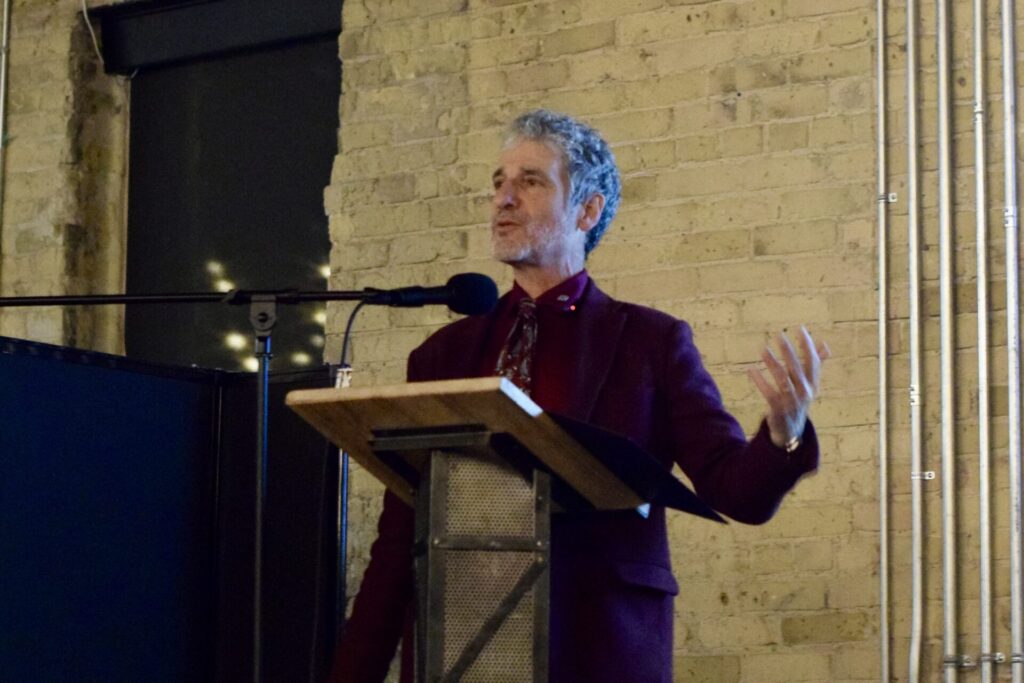
During his presentation at a recent event hosted by Green Action Centre, Litman noted that per capita car travel plateaued in the early 2000s, and demand for multimodal transportation has risen.
To illustrate this, he painted a picture of a recent walk he took in Victoria, B.C., where he works as executive director of the Victoria Transport Research Institute.
He showed photos of his walk through urban neighbourhoods, past a high school, eventually arriving at his destination:
“This is our local pub,” Litman said. The projector screen behind him showed the pub, surrounded by other businesses on a small two-lane street. He then asked the audience if it was good he was able to walk, and didn’t have to drive.
He highlighted exercise, reduced emissions, road safety, affordability, and reduced traffic congestion as benefits of walking. If he had driven, he would have added to traffic, spent money on fuel, and filled a parking spot on the street.
What’s Winnipeg doing?
The City of Winnipeg hopes to achieve similar benefits by improving infrastructure for drivers.
Plans are in place to invest at least $221 million into widening a section of Route 90 spanning just under 4 kilometres, from four lanes to six. The project aims to improve traffic congestion, reduce emissions, and strengthen cross-border trade. Over the next 50 years, the project is expected to see a return of around $10 million.
The Route 90 expansion is part of a larger infrastructure project, which includes the replacement of the St. James Bridge and combined sewers in the area. In total, it’s expected to cost $757 million, or approximately $884 per Winnipegger.
Critics, including Litman, argue the money could be better spent.
Based on past projects and adjusted for inflation, the $221 million investment could pay for more than 200 kilometres of bike lanes and paths. Winnipeg’s current cycling network spans approximately 400 kilometres.
But back to Litman’s walk to the pub. He mentioned the benefits of walking, but something is missing: speed. In most cases, walking is the slowest way to get around.
Litman said government planning “continues to assume that faster is better,” and speed is one consideration among many. Affordability, safety, equity, the environment, and cost of investment are all factors Litman would like to see given more weight.
How does this impact you?
Though the comparison to Route 90 is an isolated example, research shows improving infrastructure for walking, cycling, and transit benefits everyone.
According to Litman’s research, transportation becomes more affordable as walkability rises, and the percentage of motor vehicle commuters falls.
Fewer drivers also means less traffic, which in turn means less congestion.
“Before you spend money expanding the roads, do everything you can to improve the quality of bus travel on that corridor.” Litman said improving transit options takes cars off the road, and “the need to widen the road would disappear.”
And despite its reputation, transit is safer than other means of travel. Public transit’s death or injury rate is about one-tenth that of car travel, and overall traffic deaths typically fall as transit use increases.
What’s in the way?
A major constraint of improving multimodal transportation is car culture. While critics call it a “war on cars,” Litman’s recent work has acknowledged motor vehicle travel “can provide large benefits,” and that the goal should be “to optimize vehicle travel: not too little and not too much.”
Another barrier Litman cited is the nature of politics.
He noted that government funding currently favours automobile travel over other modes of transportation, and “there’s a lot of inertia in the system.”
Though demand has risen for multimodal transportation, political systems take time to change.
Communication between researchers, educators, voters, and politicians influences political decision-making. Litman said this is where multimodal transportation advocates have fallen short in the past.
“We’re guilty of leading with the environmental benefits,” Litman said. “It’s not just about the environment.”
This approach, he said, has promoted the idea that walking, cycling, and taking transit are solely beneficial for reducing emissions. His research, however, shows they also improve affordability, economic development, and congestion.
“If you want lower taxes,” said Litman, “the first thing you want to do is make sure the government is spending transportation dollars smartly.”
How can you express your opinion?
Winnipeggers will have an opportunity to influence the future of multimodal transportation in the upcoming municipal election.
Those who have opinions — regardless of what they may be — will be able to communicate them to candidates in the months leading up to the election, and vote on October 28, 2026.
However, “it is not generally easy to do anything as a sole citizen,” said attendee Rodney Kennish. “What you need to do is talk to your neighbours, your fellow workers, people that you have actual social connections with, and you need to figure out how to collectively solve issues.
“And it’s important that we maintain hope in that it’s possible, but not forget that believing it’s possible is not enough.”