“It’s been a long time coming,” says Stefan Hodges, West Broadway Community Organization Housing Coordinator.
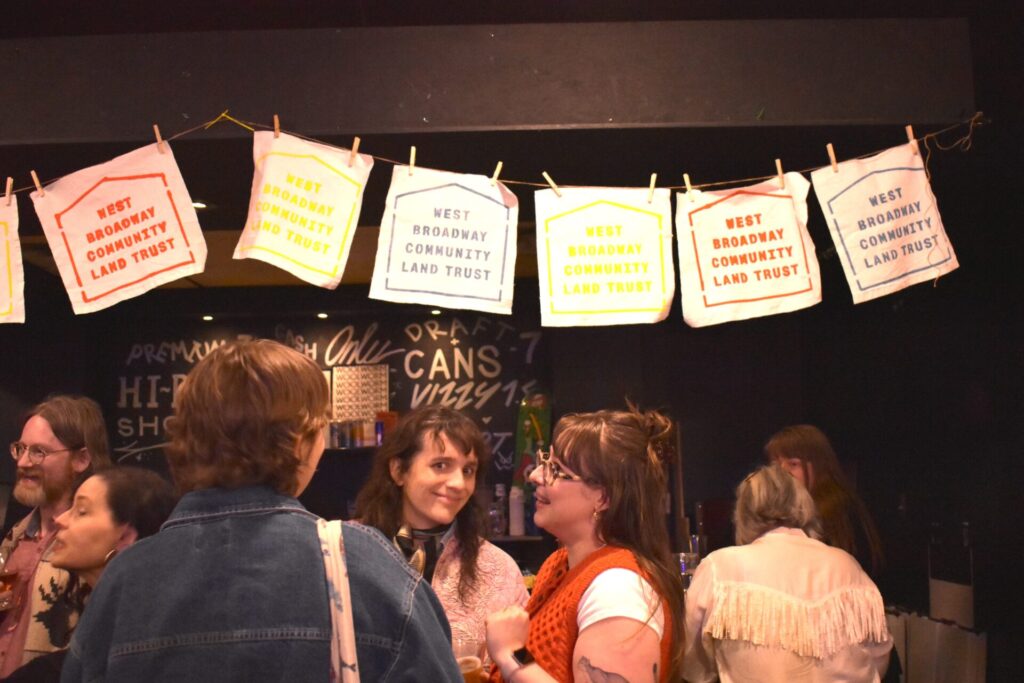
At the launch of Winnipeg’s first active Community Land Trust in over 20 years, Hodges said he was impressed by the turnout. Not only because a wide selection of people were willing to stand up and share what they love about the community on stage at the Handsome Daughter pub and eatery, but also the diversity of people who showed up.
“We had a lot of West Broadway old timers who have been involved in the community for a long time and we also had a lot of fresh faces that I hadn’t met before and that were coming into this for for the first time…it just felt like another indication that we have the community that’s willing to make this happen,” said Hodges.
Community Land Trusts have been gaining in popularity across the country along with soaring rental fees, and is one of the ways that community groups can keep housing costs down.
“The idea is to take the land off of the market because we have property values rising every time properties are bought and sold,” explains Hodges, “but instead of having profits taken from the properties and going to individuals, those profits are reinvested in the the community land trust itself, or to buy new buildings.”
In partnership with several organizations who will have membership on the board, the West Broadway Community Organization will host the Land Trust’s first board election at its Annual General Meeting at the end of May. And then it will be purchasing its first apartment building.
Services to support other coop and non-profit housing providers
“We have a really rich variety of nonprofit and co-op housing in West Broadway, and one of the challenges of running a coop, not just in West Broadway, but across Canada, and the same thing for small nonprofits, is that they’re run entirely by volunteer boards,” said Hodges.
As has been the experience in both Winnipeg and elsewhere, volunteer boards who have no staff to support their work may be missing out on funding opportunities, and sometimes there may not be enough experienced members on a board to support a coop or non-profit’s long-term viability, resulting in the loss of properties.
Hodges said there has been discussion of amalgamating some organizations, to pool resources, but he is hoping that the services the land trust could provide would allow organizations to maintain their autonomy, and get adequate supports when they “don’t have the the staff or the capacity to to do (some of the) longer term work.”
“Instead of trying to put all these organizations under one umbrella, the land trust would provide a support service to help with their financial reports, grant writing, to prepare for renovations, retrofits, and help with (planning),” he clarifies.
Longterm viability
Planning for the launch of the land trust included meetings about what hasn’t worked in the past. Although several community members were able to purchase affordable houses in the first iteration of a land trust (several who raised their families and still live in West Broadway) several factors led to its conclusion.
However Hodges says the organization is forming with much greater understanding of the hurdles it may face and the possibilities it offers.
“It is very expensive and we do have to be very business minded.. there’s no sense in keeping housing affordable if that housing falls apart or our business collapses in a year,” he says.
“Part of the beauty of the Community Land Trust is the governance model, and that’s how we balance quality with affordability. It’s like a coop where the residents take a part in decision making for their own housing, but it’s also balanced with other community members around that housing and other organizations that are based in West Broadway.
There’s a shared concern for maintaining affordability, but also maintaining the quality and the feasibility of that housing for long term.”
West Broadway has 93% renters in the neighbourhood making it a unique area of the city. Stats on the city website show that the average density of people living in city neighbourhoods is 475 people per square kilometre, while West Broadway’s density is more than 15 times higher, averaging 8,289 residents over the same space.
“Land trusts don’t need to expand, but they they can and they often do,” said Hodges. Unlike the original land trust, the WBCLT will only focus on rental buildings, making sure to keep rents affordable, and are not considering purchasing houses.
At the moment the Land Trust is considering a 10-15 unit building, of which there are more than 30 in West Broadway. “The hope is that we can really grow this thing to have a a pretty significant impact on protecting the affordability, culture and the diversity of our neighbourhood,” Hodges says.
Black farmers founded the first land trusts
The first Community Land Trust in the US was founded in Georgia in 1969 by civil rights organizers to prevent the loss of land of Black Farmers who were being discriminated against by banking institutions and government farm support programs. Called “New Communities,” the Land Trust became one of the largest Black-owned land holdings in the country by the 1980s.
“In Canada, it’s been adopted in similar ways,” said Hodges, “with real importance placed on diversity and protecting diverse urban neighbourhoods.” Several Land Trusts have been developed in Nova Scotia, Toronto and Vancouver to reclaim Black-owned land holdings, a Toronto Chinatown Land Trust is seeking to protect its cultural and community heritage, Indigenous Land Trusts are in development across turtle island, “and land trusts are being used to protect working-class spaces,” says Hodges.